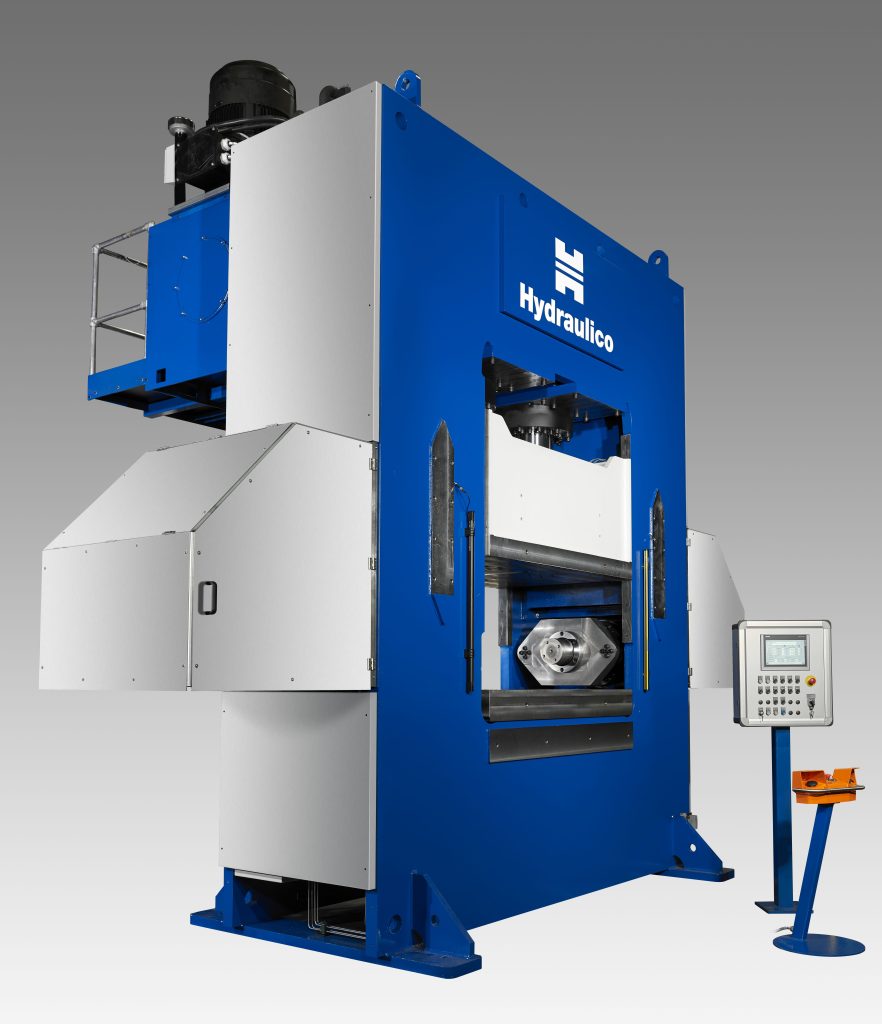
The double upsetting press is a groundbreaking multi-axis concept that consolidates multiple operations into a single blow, built to excel at pre-forming. You cut waste, gain consistency and lower cost.
Why pre-forming?
As material prices rise, pre-forming pays off. By placing material where it matters before final forging, you reduce trim loss, improve part quality, and reduce total amount of heating and forging steps while improving part-to-part repeatability. This is easily achieved with a hydraulic press because it can make a higher volume of material flow over a longer distance.
How it works
The base design includes three (3) fully independent forming axes: (1) ram or slide, (2) left side cylinder and (3) right side cylinder. Each axis is individually controlled for position, speed and force, so the press adapts to asymmetric parts and demanding sequences.
Horizontal Forming – Extrusion, upsetting and heading horizontally. Dies are easier to clean, parts release effortlessly, dies cost less, automation is simpler and full-cavity lubrication is consistent.
Double-Sided Forming– Form two ends at once or two single-ended parts per cycle. Left and right cylinders can follow different motion profiles to match asymmetric geometry.
Servo Hydraulics – Precisely control speed and force anywhere in the stroke. Manage friction peaks, extend high-speed forming stroke length and increase formability ratios.
A hydraulic press delivers a continuous, controllable punch – ideal for precise forging. In this press, the two side cylinders are servo-controlled and have a precision better than +/- 0.1 mm – even though they move with a speed of up to 350 mm per second!
The system features 3 individual forging functions:
one clamping/preform
two extrusion/upsetting functions from the sides
Metal bar and forged product
3 completely independent axis, one for die closing and two for driving punches
If you need a single press to run a variety of parts, consider the Hydraulico double upsetting press.